


News Details
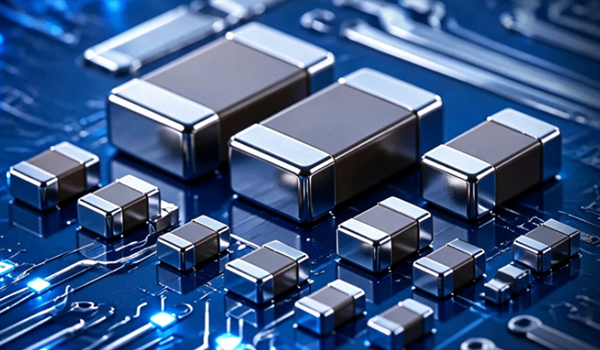

The Electronics Industry’s “Rice” Goes Crazy: MLCC Prices Surge Up to 10x in an Hour — Unpacking the Industry Forces Behind a Market of Extremes
Multilayer ceramic capacitors (MLCCs), often described as the “rice of the electronics industry,” are essential core components found across virtually every category of electronic product. In 2026, the component market is experiencing an exceptionally sharp structural split: high-end MLCCs for AI and automotive applications are in short supply and surging in price, with quotes changing by the hour and increases exceeding 10 times in the most extreme cases. Meanwhile, ordinary consumer-grade MLCCs have retreated after an initial spike. This is not simply market speculation. It reflects the combined effects of AI computing growth, a restructuring of global capacity, and rising industry demand—forces that are reshaping supply-demand dynamics and the development logic of the electronics industry.
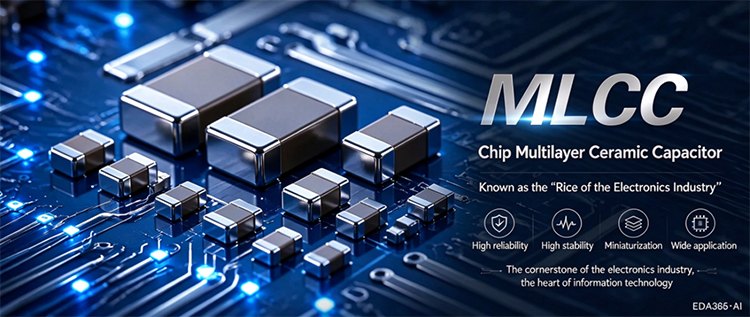
01 | The MLCC Market Splits into Two Extremes
As essential components underpinning the electronics industry, MLCCs are versatile and widely adaptable. They are used in mobile phones, home appliances, smart devices, new-energy vehicles, AI servers, and almost all other electronic equipment—hence the nickname “rice of the electronics industry.” In previous industry cycles, MLCC prices generally rose or fell together. The 2026 market has broken that pattern, producing an unusually stark divide.
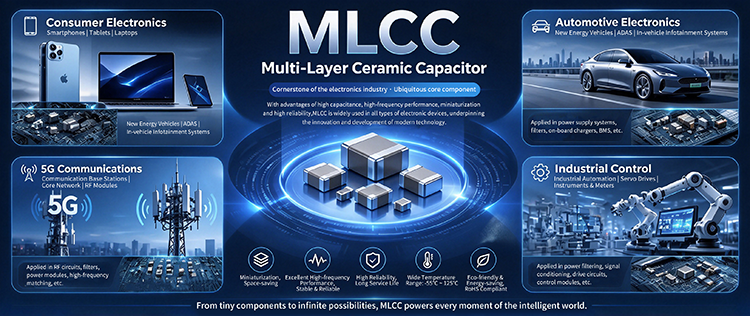
The latest price surge was triggered by major Japanese and South Korean manufacturers. Murata Manufacturing and Taiyo Yuden of Japan, along with Samsung Electro-Mechanics of South Korea, reportedly issued price-increase notices, with original-manufacturer price adjustments for high-capacitance MLCCs designed for AI servers generally in the 15%–35% range. The spot market in Shenzhen’s Huaqiangbei electronics district has been much more volatile. After demand signals emerged in late May, price fluctuations intensified throughout June. Popular high-end part numbers began changing price daily—or even hourly. Monthly increases reached 7–8 times, and prices for some scarce spot inventory rose as high as 10 times their original level.
The boom has been concentrated in high-end products; the consumer-grade market has cooled quickly. In early July, distributors began selling off inventory accumulated earlier, while demand from consumer-electronics end markets remained weak. Prices for standard, general-purpose MLCCs consequently fell rapidly. For the widely used 0603-104 part number, a purchase of 1,000 units cost only about RMB 5 in the second quarter; the price surged to RMB 30 at the end-of-June peak, but has since fallen back to around RMB 10 as speculative excesses were cleared.
The market is now split into two tracks: shortages and price increases at the high end, versus cooling demand and excess supply at the low end. This extreme contrast is not merely a short-term fluctuation; it signals a shift from old growth drivers to new ones in the electronics industry.
02 | The AI Computing Boom Creates a Structural Gap in MLCC Demand
The main immediate cause of the divided MLCC market is the explosive growth of AI computing, which has fundamentally changed the traditional demand structure. For years, consumer electronics such as phones and home appliances were the main sources of MLCC demand. The industry’s growth engine has now shifted toward AI computing equipment and high-end new-energy vehicles.
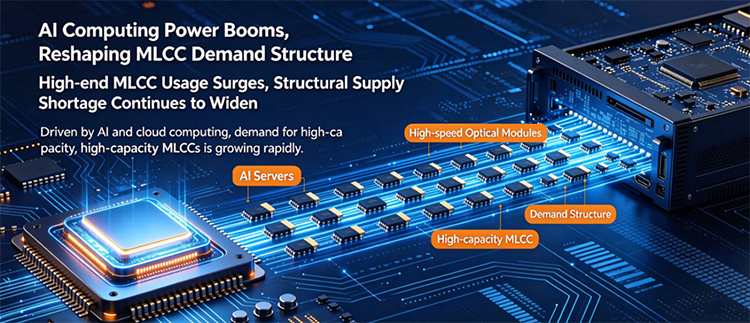
Upgrades to AI hardware have increased MLCC requirements in three ways: quantity, specifications, and performance. Industry-chain data cited in the article indicate that upgrading a standard mini PC to an AI workstation can increase total MLCC usage per device by 2–3 times. Demand for specialized high-capacitance, high-reliability models has nearly doubled. A single core circuit board may require hundreds of MLCCs to ensure stable operation in high-computing-power equipment.
At the same time, the large-scale deployment of 800G and 1.6T high-speed optical modules is widening the shortage of high-end MLCCs. A single 1.6T optical module may contain 500–1,000 MLCCs, directly driving year-on-year doubling of MLCC orders in the communications supply chain and quarter-on-quarter growth of 50%–60%. The high power consumption of AI servers is pushing the industry away from traditional general-purpose products toward high-end MLCCs that are smaller, have higher capacitance, withstand higher temperatures, and offer greater stability. Combined with sustained demand from advanced driver-assistance systems and higher-voltage platforms in new-energy vehicles, the structural gap in high-end MLCC demand continues to widen.
03 | Global Capacity Is Being Restructured, Making Supply-Demand Mismatches Persistent
The AI boom is only the catalyst. The deeper reason for long-term shortages and price increases in high-end MLCCs is the strategic reallocation of capacity by global leaders—an industry reality that is easily overlooked.
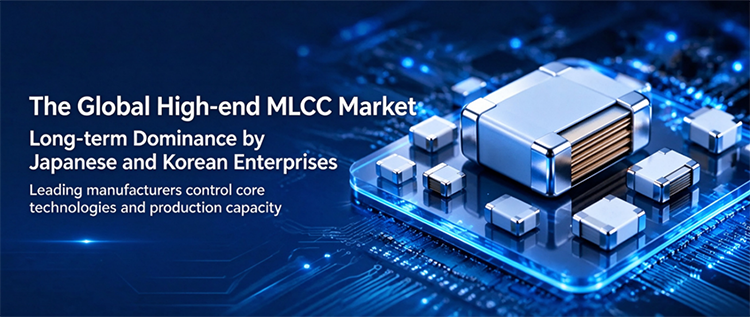
The global high-end MLCC market has long been dominated by Japanese and South Korean companies, whose leading manufacturers control core technologies and production capacity. In response to the higher-profit opportunities in AI and new energy, overseas giants are restructuring their capacity: actively reducing production of lower-margin consumer-grade MLCCs and redirecting key production lines, R&D resources, and capacity toward AI-server and automotive-grade high-end MLCCs.
This strategic shift has created a supply-demand mismatch. Demand in high-end segments is growing rapidly while corresponding high-quality capacity is being deliberately constrained, widening the supply gap. Market anxiety has spread, and distributors have stockpiled and locked up large quantities of inventory, further tightening spot supply. Procurement practices among downstream manufacturers have changed substantially: instead of placing flexible orders one to two months ahead, companies are now reserving capacity three to six months in advance, significantly extending lead times.
According to the article, orders for high-end AI-specification MLCCs at domestic manufacturers have been booked through the second quarter of 2027, while lead times have lengthened from the usual 6–8 weeks to 16 weeks. Industry organizations expect the high-end supply gap to persist from the fourth quarter of 2026 through the first half of 2027. Even as new domestic capacity gradually comes online in the second half of 2027, supply and demand may not fully balance for the year; structural shortages could become a long-term norm.
04 | Localization Accelerates, Exposing Weaknesses in Traditional R&D Systems
Capacity shifts by overseas leaders have created a rare opportunity for domestic MLCC suppliers to replace imports. Faced with persistent shortages of high-end components, downstream companies are gradually reducing their dependence on overseas sources and turning to qualified domestic suppliers. The article says orders at leading domestic companies rose sharply, with third-quarter orders reaching twice the first-quarter level. Chinese manufacturers are expanding capacity, focusing on high-end AI and automotive-grade MLCCs. Once some new production facilities are fully operational, their monthly standardized capacity is expected to approach 80 billion pieces, accelerating domestic substitution.
However, the capacity shortage has also exposed a less visible weakness in the electronics industry. Many domestic hardware companies still use traditional R&D processes in which design, component selection, procurement, and production operate in silos, creating serious information barriers. During design, engineers may focus only on electrical specifications and overlook price volatility, lead-time risks, and supply stability. Shortages or sharp price increases in critical MLCC part numbers may not be discovered until schematics are finalized and the bill of materials (BOM) is issued.
This late-stage approach to risk creates recurring difficulties. Companies may have to buy scarce spot inventory at inflated prices, squeezing margins, or redesign circuit boards and repeat validation, delaying projects and missing market opportunities. Some companies replace MLCCs without adequately checking parameter compatibility or process fit, leading to unstable equipment performance, mass SMT defects, and substantial financial losses. In a market where MLCC prices can change several times in a day, traditional manual screening and offline sourcing are no longer efficient enough.
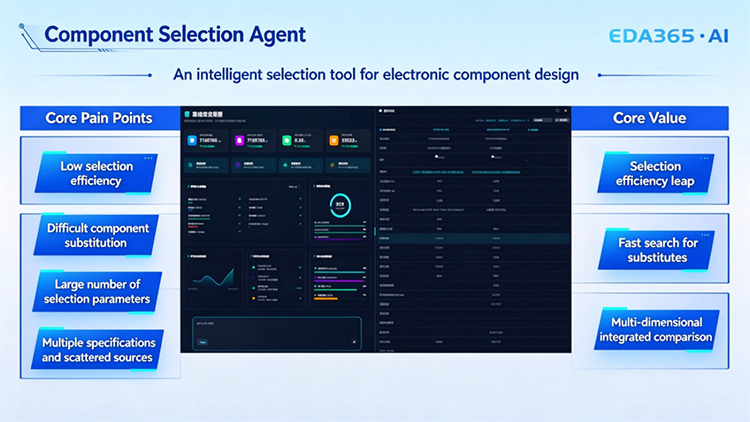
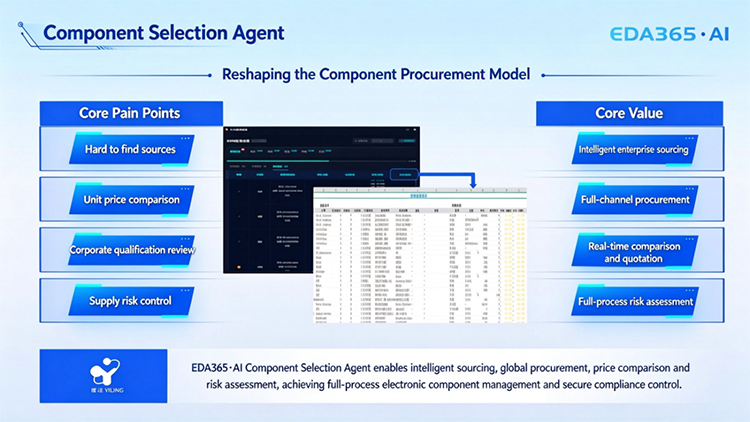
Against a backdrop of recurring market cycles, digitizing R&D and supply-chain processes is becoming a core competitive advantage. The article presents EDA365·AI as an end-to-end industrial AI solution that connects design, component selection, BOM verification, process review, and supply-chain matching. It aims to move material-risk management from reactive “firefighting” to early prevention at the design stage, help engineers avoid scarce or rapidly rising-price components, and intelligently match compliant domestic alternatives—addressing the disconnect between R&D and supply chains.
05 | A Structural Market Opens a New Cycle for the Electronics Industry
The tenfold MLCC price spikes and the sharp split between hot and cold market segments are, in essence, a reflection of the electronics industry’s transition from old growth drivers to new ones. The era of broad-based growth in consumer electronics is fading, while AI computing and high-end new-energy manufacturing are becoming the industry’s main growth engines, fundamentally reshaping the supply-demand system and value structure of basic components.
Going forward, the era in which all MLCC categories rise and fall together may be over. Structural divergence—scarcity at the high end and oversupply at the low end—is likely to persist. For electronics companies, a crude model based solely on overseas supply chains and inventory hoarding to manage risk is no longer effective.
The dramatic changes in the MLCC market are not just another component-price cycle; they are an important signal of the transformation and upgrading of China’s electronics industry. Deeper localization, digitalized R&D, and earlier risk management are likely to be key trends. Companies that adapt to the new industry cycle and upgrade their R&D and supply-chain systems will be better positioned to navigate volatility and capture opportunities in the AI-computing era.
Should you wish to dive deeper into component market trend analysis, supply chain risk assessment, domestic substitution cases or intelligent component selection solutions, you are welcome to send your questions and collaboration requests to mailto:[email protected]. We look forward to in depth communication with electronics industry engineers, procurement specialists and enterprise decision makers.

Customer Feedback
Name *
Enter Name *
Email *
Enter Email *
Corporate Nature *
Choose a Corporate Nature *
Message