


News Details


TI Automotive Chip Prices Surge Amid Supply Tightness
Spot market volatility, longer lead times, and recovering automotive demand are reshaping the supply landscape for Texas Instruments components.
TI Automotive Chips See Sharp Price Increases in the Spot Market
Texas Instruments (TI) automotive-grade semiconductors have attracted significant attention in the electronic components market in recent weeks. Distributors are reporting a surge in inquiries, substantial price increases, and growing difficulties in securing certain automotive-grade components.
According to market discussions, some TI components with the "-Q1" automotive-grade designation have experienced dramatic price increases. Products previously priced at just a few yuan are reportedly being quoted at several hundred yuan, with significant differences between suppliers.
Third-party trading platforms have also shown considerable price fluctuations. Some automotive-grade components that were available for tens of yuan in June and July are now being offered at several hundred yuan.
However, market participants emphasize that pricing remains highly inconsistent. While demand has increased, actual transaction volumes vary considerably among distributors.
Supply Constraints and Extended Lead Times
Several distributors began noticing changes in the TI automotive semiconductor market as early as July 2026.
Initial signs included tighter availability, extended lead times, and price increases for selected components. By September, more distributors were reporting shortages, although demand remained spread across multiple product categories rather than concentrated on a few popular part numbers.
Recent market observations indicate that immediate stock availability has become increasingly important for successful transactions.
Several TI product families have reportedly experienced particularly noticeable price movements:
LM74700 Series: Certain components have seen prices increase several times compared with June levels, while customer demand remains active.
LM5148 Series: Some parts previously priced at approximately RMB 15 in early September are now reportedly quoted at RMB 30–40, with limited availability.
DRV8718 Series: Selected components have experienced significant price increases and supply constraints.
TPS4H160 Series: Certain models have reportedly more than doubled in price, with difficulties in securing stock.
The volatility has also extended beyond automotive-grade products. Some standard commercial-grade components, including products in the TMUX1308 family, have reportedly experienced unusual price increases.
These developments suggest that the current market situation is being driven by a combination of genuine supply constraints, stronger demand, and speculative pricing in the spot market.
How the TI Automotive Chip Market Developed in 2026
The current market activity appears to have developed gradually over several months.
July 2026 — Early Signs of Supply Tightness
Some distributors began identifying potential shortages and longer lead times for selected automotive-grade components.
Industry reports suggested that delivery schedules for certain products were extending from approximately 8–12 weeks to 16–20 weeks.
August 2026 — Increasing Supply Pressure
Market participants reported growing supply constraints affecting selected Q1 automotive-grade components.
Distributors began purchasing inventory in anticipation of potential shortages and higher prices.
September 2026 — Greater Price Volatility
Following reports of TI pricing adjustments, spot market quotations became increasingly volatile.
Automotive, industrial, and server-related components were among the product categories experiencing notable price movements.
October 2026 — Stronger Demand and Market Activity
By mid-October, more distributors reported a noticeable increase in demand for TI automotive components.
However, the market remained fragmented, with limited availability concentrated in specific part numbers and substantial pricing differences among suppliers.
Unlike previous semiconductor shortage cycles, the current situation has not produced a clearly defined group of universally high-demand components.
Instead, supply constraints appear to be distributed across multiple product families, particularly power management and automotive-related semiconductors.
TI Financial Performance Shows Strong Recovery
The growing activity in the spot market coincides with a broader recovery in Texas Instruments' financial performance.
TI's quarterly revenue reached approximately USD 5.24 billion in the third quarter of 2022 before entering a prolonged downturn.
Revenue eventually declined to approximately USD 3.66 billion in the first quarter of 2024, marking a low point in the cycle.
The recovery began to take shape in 2025.
In the first quarter of 2025, TI reported year-over-year revenue growth of 11.1%, returning to positive annual growth after more than two years of contraction.
Full-year 2025 revenue reached approximately USD 17.68 billion, representing 13% growth.
Strong Revenue Growth Continues in 2026
TI's financial performance accelerated further during the first three quarters of 2026.
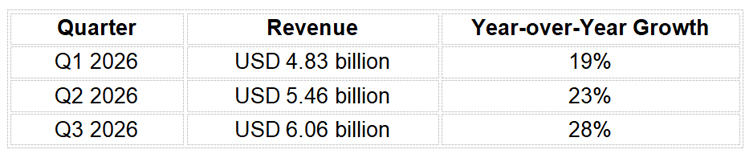
By the second quarter of 2026, TI's quarterly revenue had already exceeded its previous peak in 2022.
Growth continued into the third quarter, supported by recovering demand across industrial, automotive, and data center markets.
Automotive Demand Becomes a Key Growth Driver
Industrial and data center applications initially led TI's recovery.
However, automotive demand has increasingly contributed to the company's growth since the second quarter of 2026.
Automotive has long been one of TI's most important end markets.
In 2025, automotive revenue reached approximately USD 5.8 billion, accounting for around 33% of total revenue.
Nevertheless, the automotive segment initially recovered more slowly than other business areas.
During 2025:
Data center revenue increased by approximately 64%.
Industrial revenue grew by approximately 12%.
Automotive revenue increased by approximately 6%.
The situation began changing in 2026.
Automotive Recovery Accelerates in Q2
During the second quarter of 2026, TI reported double-digit year-over-year growth in its automotive business.
According to CEO Haviv Ilan, the recovery was primarily driven by China, particularly electric vehicles (EVs) and hybrid electric vehicles (HEVs).
Automotive customers had also reduced their inventory levels significantly, creating additional demand as purchasing activity recovered.
Automotive Momentum Continues in Q3
In the third quarter, TI's automotive business maintained double-digit year-over-year growth, with sequential growth of approximately 10%.
China and the United States were the primary contributors.
Demand related to hybrid vehicles, electric vehicles, and powertrain applications grew at approximately twice the rate of the overall automotive business.
TI management indicated that automotive demand remained strong, while customer inventory levels appeared relatively lean.
However, the company also acknowledged that its manufacturing operations could not immediately deliver every required product mix.
Certain specialized components would require additional production planning to meet customer demand.
This mismatch between overall manufacturing capacity and demand for specific products may help explain why selected automotive-grade components are experiencing tighter availability despite TI's broader production capabilities.
TI Inventory Levels Continue to Decline
TI's inventory data also reflects the changing supply and demand environment.
At the end of the fourth quarter of 2025, the company's days of inventory reached 222 days, up from 215 days in the previous quarter.
Inventory levels subsequently declined throughout 2026.
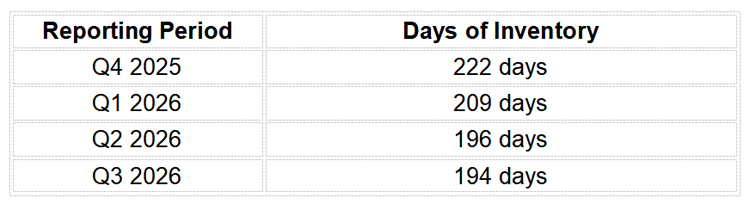
The decline over three consecutive quarters indicates that TI has been reducing its inventory position as customer demand recovers.
While the company previously stated that it was not experiencing widespread supply shortages, strong demand has gradually placed additional pressure on lead times.
By the third quarter, TI acknowledged that lead times could increase modestly in certain product categories.
Despite these pressures, the company maintained that its delivery performance remained competitive.
TI Pricing Outlook and Supply Chain Challenges
Pricing has become another major concern for semiconductor buyers.
According to TI's third-quarter commentary, product pricing remained relatively stable on a year-over-year basis during the first half of 2026.
Prices subsequently increased to some extent during the second half, although the company indicated that the overall increases were not particularly significant.
Market reports also referenced several TI pricing adjustments during April, July, and September 2026.
These adjustments have been associated with rising supply chain costs, evolving market conditions, and recovering demand across industrial, automotive, and data center applications.
At the same time, lead times for certain TI products have reportedly extended to 48 weeks or longer.
TI has also begun discussions regarding 2027 pricing and supply commitments.
Additional information on pricing developments may become available when the company releases its next financial results and guidance.
It is important to distinguish between manufacturer pricing adjustments and quotations in the independent distribution market.
Spot market prices can be influenced by immediate availability, inventory positioning, buyer urgency, and speculative trading.
Consequently, unusually high quotations do not necessarily represent official manufacturer price increases.
What Does This Mean for Semiconductor Buyers?
The latest developments highlight several important considerations for automotive electronics manufacturers and component procurement teams.
1. Monitor Lead Times and Stock Availability
Certain automotive-grade components may experience extended delivery schedules even when the manufacturer's overall production capacity remains sufficient.
Buyers should regularly review availability and confirm delivery commitments for critical part numbers.
2. Evaluate Spot Market Pricing Carefully
Large differences between supplier quotations can indicate market volatility rather than a consistent change in component value.
Procurement teams should compare multiple sourcing channels and carefully verify inventory, traceability, and delivery conditions.
3. Identify Alternative Components Early
For components with extended lead times or unusually high prices, evaluating technically compatible alternatives can help reduce procurement risks.
Any proposed replacement should undergo appropriate engineering validation, particularly in automotive applications requiring specific qualification and reliability standards.
4. Strengthen Supply Chain Flexibility
Maintaining access to multiple qualified sourcing channels and developing alternative component strategies can help manufacturers respond more effectively to changing market conditions.
Looking Ahead
The recent surge in TI automotive-grade component prices reflects a semiconductor market undergoing another period of adjustment.
Recovering automotive demand, lower customer inventories, and manufacturing constraints affecting specific product mixes have contributed to tighter availability.
However, significant differences between spot market quotations suggest that not all reported price increases reflect the same underlying supply conditions.
For semiconductor buyers, the priority is to distinguish genuine supply shortages from short-term market speculation while securing reliable supply for critical applications.
As automotive electrification continues to expand, demand for power management, interface, and other automotive-related semiconductor technologies is likely to remain an important market factor.
Looking for TI Alternatives or Reliable Component Sourcing?
At eRUN, we help global customers navigate semiconductor supply challenges through electronic component sourcing, alternative component solutions, and supply chain integration.
Whether you are facing extended lead times, rising component costs, or limited availability of TI automotive-grade semiconductors, our team can help you explore suitable sourcing options and technically compatible alternatives.
Contact eRUN: [email protected]
Website: www.erunsolution.com



Customer Feedback
Name *
Enter Name *
Email *
Enter Email *
Corporate Nature *
Choose a Corporate Nature *
Message